Archives - Page 2
-

Semiotics and post memory II
Vol. 1 No. 45 (2021)Also dedicated to the subject of post-memory, this second volume now explores its limits and frontiers. Temporal, epistemological and discursive, phenomenological, psychic and (epi) genetic boundaries. The articles that are part of this volume attempt to contribute to the joint effort to conceptualize post-memory.
-
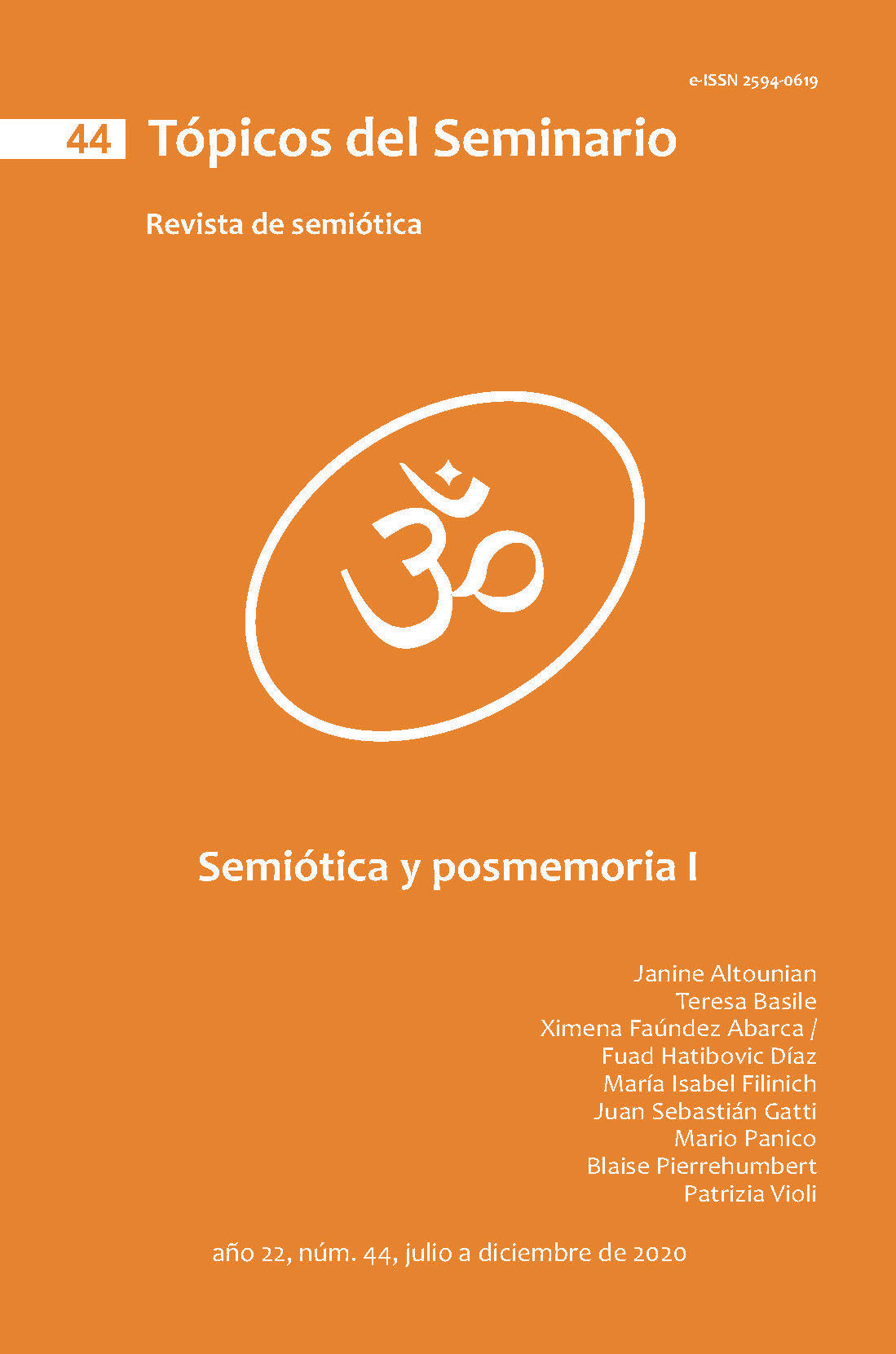
Semiotics and post- memory
Vol. 2 No. 44 (2020)This issue of Tópicos del Seminario is dedicated to the study of post-memory, understood as the transmission of the memory of the generation that experienced collective trauma firsthand to subsequent generations. Based on the dialogue between different disciplines, and starting from the analysis of the most diverse historical experiences –the Holocaust, the Armenian genocide, the dictatorships of Latin America… -, this joint reflection is oriented towards the conceptualization and theorization of said phenomenon thanks to the identification of its "invariable" foundations, its scope and its limits.
From the body to the discourse, and from the unrepresentable of extreme experience to its possible elaboration, each author thus contributes elements of response to the enigma of post-memory, exploring the area in which it constructs a universe of significance.
-
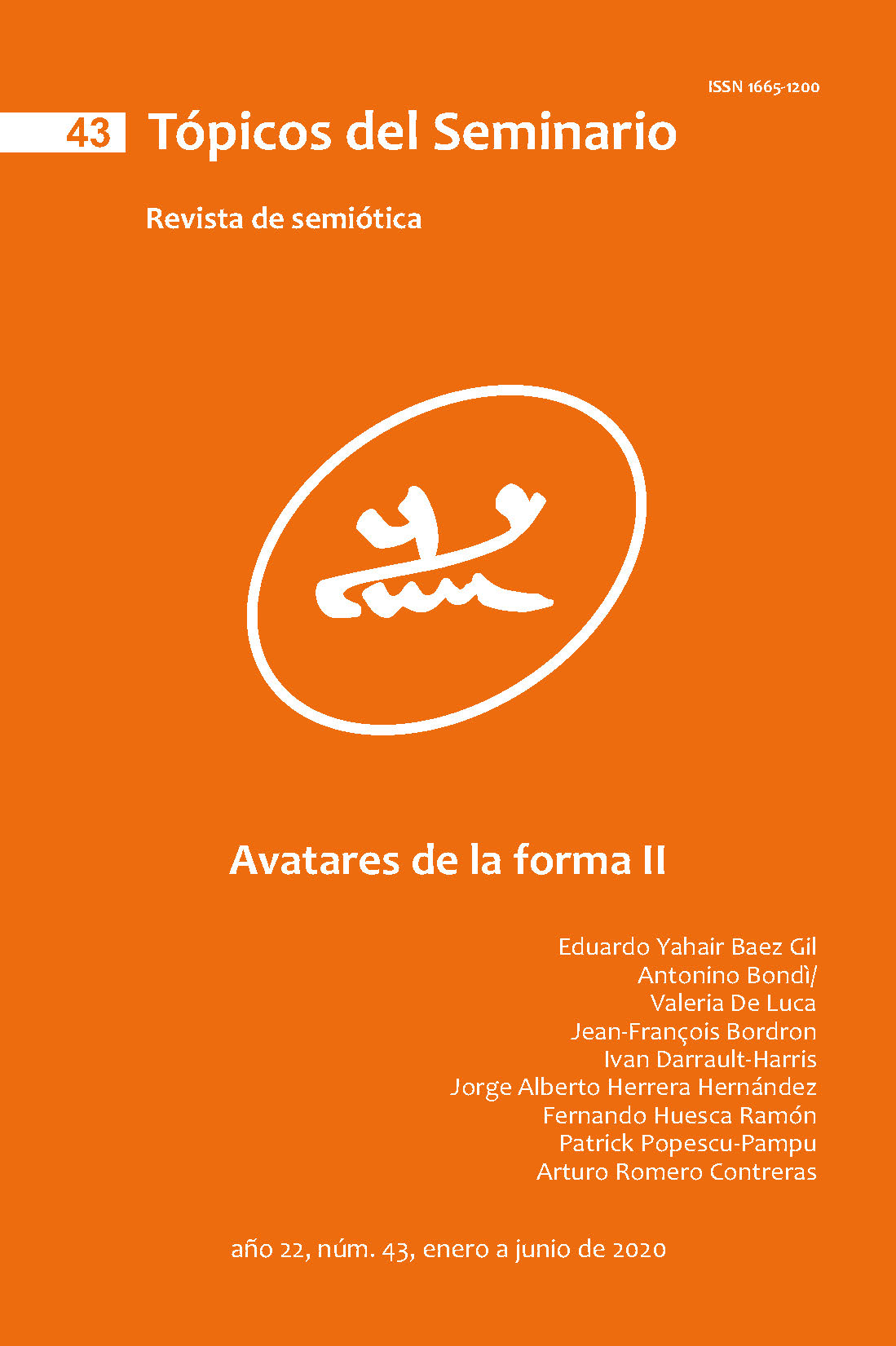
Avatars of Form, II
Vol. 1 No. 43 (2020)One of the main threads of this second volume dedicated to the Avatars of form has been to place the arts, sciences, mathematics and philosophy on the same terrain, bearing in mind that this same terrain does not form, by any means, a totality because there is no such thing as a great form that connects all the forms with which each discipline is concerned. If each discipline is conceived as a space, one would say that these are related according to modes of connectivity, a concept that is more appropriate to leave behind that of totality that implies, in general, a simple model and that pretends to conquer monism by simplification. Thus, form has been considered the central aspect that makes it possible to build all the bridges and become a transversal concept that configures knowledge and human experience, as evidenced in the series of articles gathered here, which, from semiotics, anthropology, language sciences, mathematics and philosophy discuss the concept, expression and manifestation of form linked to perception, cultural complexity, art, aesthetics and geometry.
-

Avatars of Form I
Vol. 2 No. 42 (2019)As with widely spread and used concepts, it is not easy to know what is meant by form. The form that intervenes in the composition of the Aristotelian substance has little to do with the form of the leaves, and these with the form of sentences. The world of form appears to us today as heterogeneous and complex, but also as a vehicle that allows us to establish structural similarities between the most distant conceptual regions (biology and linguistics, physics and logic, mathematics and psychoanalysis).
From different perspectives and fields of knowledge, the authors gathered here reflect on the concept of form and the different enigmas, incarnations and mutations that science and human beings have unfolded.
-

On Subject and Subjectivity, II
Vol. 1 No. 41 (2019)Starting from the existing general understanding of the concept subject —as function and active principle that can be figurativized until reaching the human subject—, the contributions gathered here explore the different perspectives of analysis that this word has acquired and its inescapable relationship with other terms such as subjectality, subjectivation, subjectivism, intersubjectivity, subjectity, etc.
This second installment on subject and subjectivity contains critical approaches, articles that resume the definitions developed by the sciences of language and semiotics of structural origin —including the semiotics of the body and tensive semiotics—, works that make semiotics dialogue with other disciplines, and texts that address specific problems in the field of artificial intelligence.
-

On Subject and Subjectivity, I
Vol. 2 No. 40 (2018)For semiotics of linguistic and structural origin, the notion of subject constitutes a cornerstone of the theory, so the interest in resuming the problem of the subject without detaching it from subjectivity —with which it is in fact associated— and facing it as a conceptual knot in itself. In the contributions gathered here, the reader will find from reflections on the epistemological origins of both notions, passing through semiotic analyses of specific cases, to works that link the notions of subject and subjectivity with disciplines such as rhetoric, poetics and philosophy, and texts that link them with intersubjectivity or consider them in light of the new semiotic practices.
-

Environmental Semiotics
Vol. 1 No. 39 (2018)Adoptando una perspectiva interdisciplinaria, los trabajos reunidos en este volumen ponen en el centro de la reflexión la significación de las prácticas socioambientales, con el propósito de fortalecer el andamiaje conceptual de una semiótica ambiental. Los estudios de caso que se presentan evidencian la pertinencia de estas indagaciones, como así también la posibilidad de incorporar a los mismos agentes en la valoración de sus formas de vida y en la generación de prácticas acordes con su ecosistema. -

Miscelánea
Vol. 2 No. 38 (2017)Artículos de diversas temáticas, referidos tanto a textos en soporte impreso como digital (videojuegos, Facebook, Twitter), son recogidos en este volumen con el propósito de ofrecer al lector un panorama de la pluralidad de objetos de estudio que reclaman hoy una reflexión semiótica y estimulan el diálogo con otras disciplinas.
-

The Principle of Narrativity. Tribute to Greimas
Vol. 1 No. 37 (2017)Honoring the scientific spirit of Greimas, who conceived semiotic theory as a process in constant construction thanks to the inherent meta-semiotic activity that animates it, this issue brings together current reflections by Latin-American semioticians on the principle of narrativity. In order to examine the heuristic value of this principle to its full extent, a journey is made from its historical-epistemological origins, going through the great development it had and by which the projection of semiotics took place as a possible methodology for social sciences, to contemporary semiotics, which is called to consolidate its own disciplinary identity and to give answers to the different forms that signification has been acquiring in recent times.
-

Modes of believing
Vol. 2 No. 36 (2016)Believing is part of the so-called epistemic modalities, which are defined as a cognitive force that leads subjects to consider true either something they can verify or demonstrate or something unverifiable —but likely or possible. Therefore, the form taken by that cognitive force is that of knowing —as in the logical or scientific discourse— and believing —implied in political, advertising or religious discourse.
The contributions in this issue reflect on the cognitive modality of believing and the modes it is presented within the various fields and their discourses: as a determinant of an activity, as an intentional effect, as a mode of existence, or as a form of expression.